


Speech privacy / sound masking are a rapidly growing category in the commercial AV market. If you are researching sound masking you may have seen the terms indirect field and direct field to describe masking systems. How do you know which one is best for your facility so that you can make the right choice?
Indirect Field Sound Masking (Up-Firing)
AtlasIED has always been a proponent of indirect field sound masking and therefore is usually the solution we recommend as long as it will work in the environment. The key characteristic of a sound masking system for it to do what it is supposed to do, is that the system appear to be invisible to anyone in the area where the masking is deployed. This characteristic is made for indirect masking where the speakers are located either above the ceiling tiles or treatments or below the floor. Since a sound masking speaker is always emitting white or pink noise it can be a distraction to people in the masking area as they can point to the speaker and say "that speaker is making noise and is bothering me."
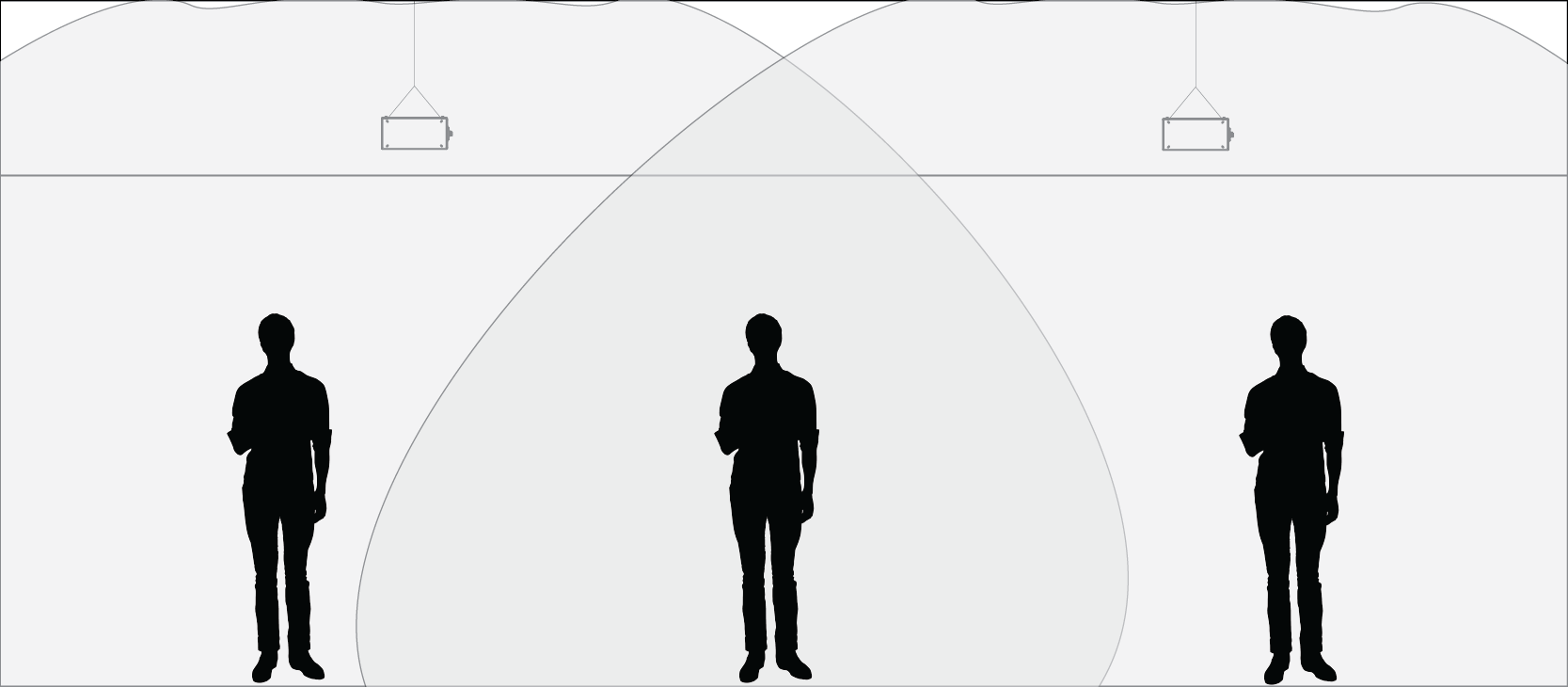
If the speaker is above the ceiling tile, as illustrated in the example below, the listeners' cannot identify the source of the white/pink noise. Additionally, installing the speakers firing up toward the deck above the ceiling tiles allows the sound masking noise to permeate the entire space and fully cover the area so there are no "dead" areas without coverage.
Direct Field Sound Masking (Down-Firing)
There are some instances where indirect masking just will not work and direct field masking is the only available option. The key to a direct field masking system is trying to eliminate "dead" spots in the room so that the masking system can appear to be as invisible as possible.
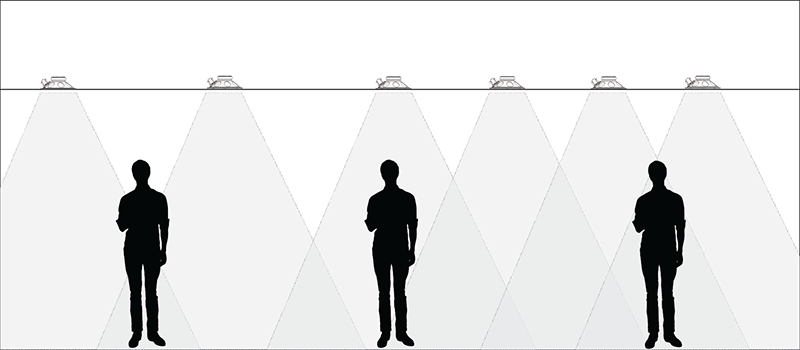
The below image illustrates a direct field masking system with a standard in-ceiling speaker. The speaker has a limited dispersion pattern so as is illustrated on the left side of the image, there are "dead" spots in the coverage because the speakers are spaced too far apart for the coverage pattern of the speaker to cover the listener while standing. That may not seem like a big deal because the occupants are normally going to be seated but as people move around the office they will be going in and out of the masking field, which will keep the system from remaining invisible and causing it to become a distraction resulting in employee dissatisfaction. In order to maintain consistent coverage across the room, the number of speakers used in the system needs to be increased in order to completely cover the area as illustrated on the right side of the image, resulting in higher system hardware and installation costs.
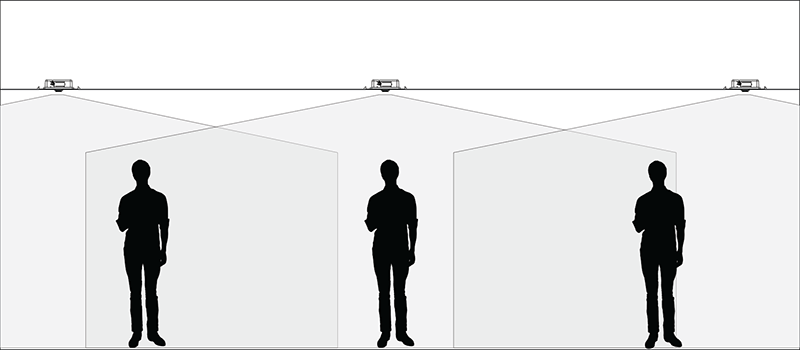
The next image illustrates a direct field masking system using a speaker with a much wider coverage pattern, in this example the AtlasIED Strategically Hidden Speaker (SHS) model SHS-6T2. This speaker has a coverage pattern up to 150 degrees, which is much wider than a standard ceiling speaker. Additionally, its cosmetic, a 3" lens that looks like a sprinkler head, makes the speaker disappear into the ceiling assisting in making the sound masking to remain "invisible". Since the coverage pattern is so much wider with the SHS, fewer speakers are required to cover the same space and "dead" spots are easy to eliminate across the entire space. Additionally, the combination of a Z Series acoustical system with SHS-3T2 speakers offer a solution that is easy to install, has pre-configured settings for sound masking systems, and can also be used for paging and background music.
One other point to make, Direct Field Masking Systems require 2-masking channels, each one wired to an alternating speaker in an “A” “B” fashion. So the channel “A” goes to the first speaker, the next speaker gets channel “B”, the next gets “A” again, etc. This technique greatly reduces the audible “comb filtering” effect one can hear when walking in a space with all speakers reproducing the same signal. It’s not so bad with voice or music, but a constant, random noise signal would cause negative occupant reactions without an alternating signal scheme.
Conclusion
At the end of the day it is possible to successfully do both indirect and direct sound masking systems and AtlasIED has all of the equipment necessary to get the job done right. Our team of expert system designers is available to assist in helping you choose the system that will work best for your facility. Visit atlasied.com/design_assistance to learn more and to submit your design assistance request.
Frequently Asked Questions
What is the difference between direct field and indirect field sound masking?
Indirect field masking (up-firing) places speakers above the ceiling tiles or below the floor, so the sound source is invisible to occupants and the noise permeates the space evenly. Direct field masking (down-firing) mounts speakers at or in the ceiling, aimed into the room. Both approaches aim to make the masking sound feel invisible, but they get there differently.
Which type of sound masking does AtlasIED recommend?
AtlasIED generally recommends indirect field masking when the environment allows for it. Firing the sound upward into the ceiling deck keeps occupants from identifying the noise source and helps eliminate dead spots, so the system stays unnoticed rather than becoming a distraction.
When is direct field masking used instead of indirect masking?
Direct field masking is the practical option when indirect masking is not possible in a given space, such as when there is no usable area above the ceiling or below the floor to install up-firing speakers. In those cases, down-firing speakers are mounted directly at the ceiling line instead.
Why does direct field masking sometimes cost more to install?
Standard ceiling speakers have a limited dispersion pattern, so a direct field system needs more speakers spaced closer together to avoid dead spots as people move through the room. Using a wider-coverage speaker, such as the AtlasIED SHS-6T2 with up to 150 degrees of coverage, reduces the number of speakers needed and helps control that added cost.
What is comb filtering, and why does it matter for direct field masking?
Comb filtering is an audible distortion that occurs when multiple speakers reproduce the same constant noise signal in an overlapping space, which listeners notice as they move around the room. Direct field masking systems reduce this effect by wiring alternating speakers to two separate masking channels, commonly labeled A and B, instead of feeding every speaker the same signal.
Can a facility use both direct and indirect masking in the same building?
Yes. AtlasIED supports both approaches and it's common for a single facility to use indirect masking where the ceiling allows for it and direct masking in areas where it doesn't. AtlasIED's Design Assistance team can help determine the right approach for each space.