


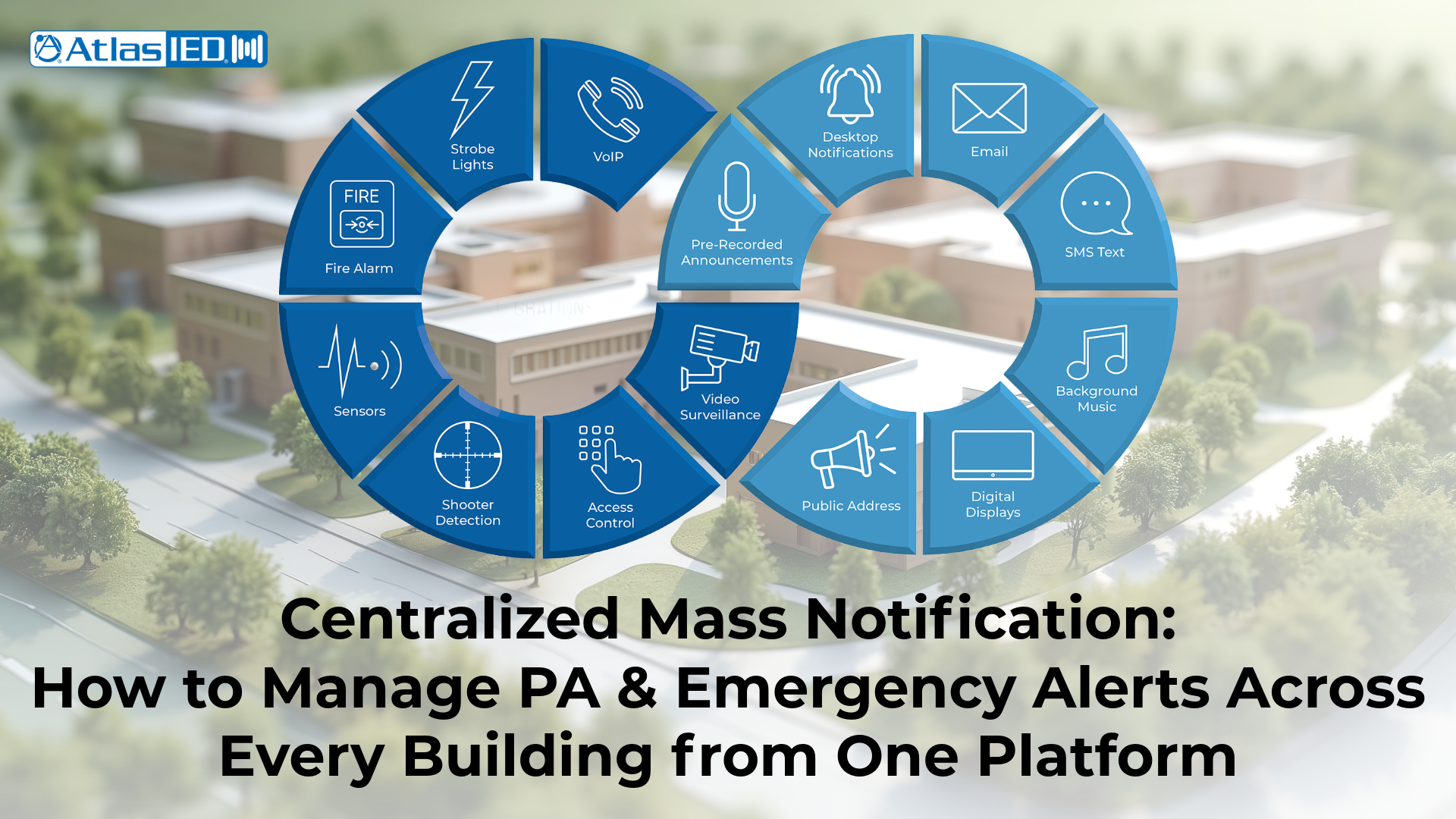
If your organization has more than one building—a campus, hospital system, chain of facilities, or transit network—you need a reliable way to manage paging, scheduled announcements, and emergency alerts across every site. In many facilities, that same communications strategy may also coordinate with background music, intercom, digital signage, access control, and other building systems.
The answer is a centralized mass notification architecture: a single operational approach that can control IP-connected endpoints, integrate with existing analog audio where needed, and deliver consistent messages across buildings, outdoor areas, and off-site recipients.
Why centralization matters
Decentralized systems—where each building runs its own paging or alerting equipment—create three predictable problems: inconsistent messaging, delayed cross-site alerts, and added operational overhead for IT, security, and facilities teams.
In fast-moving emergencies, delay matters. The FBI’s analysis of active shooter incidents found that, in the 63 incidents where duration could be determined, 44 ended in five minutes or less and 23 ended in two minutes or less. Separately, an FBI Law Enforcement Bulletin analysis of 51 active-shooter cases with available response-time data reported a median police response time of three minutes. A centralized platform helps reduce the time spent manually contacting each building one by one.
What a centralized IP-based platform looks like
A modern centralized mass notification system typically has three layers:
1. A mass notification head-end
This is where operators compose messages, manage zones, control contact lists, and trigger delivery. For IP-based deployments, Singlewire InformaCast is the platform AtlasIED distributes and integrates with directly. For organizations centered on IPX endpoints, AtlasIED IPX Administrative Control Consoles and VoIP paging tools can support on-network paging and communication across IPX devices.
2. Connected endpoints at each location
Endpoints can include overhead speakers, visual displays, flashers, intercom stations, gateways, desktop devices, and outdoor loudspeakers. AtlasIED IPX Series endpoints use existing network infrastructure for audible and visual communication, while IPX IP-to-analog gateways can extend digital notification and messaging to analog amplifiers and speakers where a full IP conversion is not practical.
3. A multi-modal delivery layer
A centralized system should not depend on overhead audio alone. InformaCast can help extend the same alert to desktops, mobile devices, SMS, email, and other approved recipient channels, helping reach people in classrooms, offices, parking areas, remote workspaces, or off-duty roles.
When a purpose-built enterprise ecosystem is the right call
For large, mission-critical installations—such as airports, transit hubs, hospital campuses, and industrial sites—organizations may require a purpose-built enterprise communication ecosystem rather than a lighter IP notification overlay. AtlasIED GLOBALCOM supports mass communication, paging, and voice evacuation with dedicated controllers, amplifiers, digital communication stations, system supervision, fault reporting, message confirmation, and integrations with systems such as VoIP, public address, fire, security, and access control.
Centralization is also a governance decision
Centralized notification is not just a hardware upgrade. It requires a shared operating model across IT, facilities, security, communications, and site leadership. Before rollout, teams should define naming conventions for buildings and zones, role-based permissions, message templates, escalation rules, test schedules, contact-list ownership, and after-action reporting.
That governance work is especially important for multi-site organizations. A weather alert may need to reach one region only. A security incident may need to reach every building. A maintenance message may belong in one wing, while a life-safety message may need priority over every other audio source. The system design and the operating procedure should match those realities.
Common centralized notification applications
Once in place, organizations can use the architecture for more than emergency alerts. Common applications include daily paging, scheduled announcements, bell schedules, severe-weather alerts, wayfinding, code calls, evacuation instructions, shelter-in-place messages, operational updates, and staff communications across K-12 districts, higher-ed campuses, healthcare systems, corporate enterprises, industrial sites, and transportation hubs.
For a tailored architecture, AtlasIED Design Assistance can map the right combination of IPX, InformaCast, and, where appropriate, GLOBALCOM to a specific facility footprint.
Sources cited in body: FBI active shooter incident analysis; FBI Law Enforcement Bulletin police-response analysis