



Loudspeaker voicing is the process of shaping a speaker's frequency response, tonal balance, phase behavior, and overall sonic character so that it reproduces audio in a predictable and desirable way. In loudspeaker design, voicing is often one of the most important — and most overlooked — factors affecting system performance.
Why voicing matters in commercial AV
Most published specifications — sensitivity, frequency range, maximum SPL — describe what a loudspeaker can do. They do not describe how it sounds. Two loudspeakers with nearly identical spec sheets can deliver completely different listening experiences. Voicing is where that difference lives, and it has direct consequences for speech intelligibility, system consistency, commissioning time, and long-term listener comfort.
Speech intelligibility
Many commercial AV systems are deployed primarily for speech reinforcement — corporate meeting rooms, houses of worship, airports, educational facilities, and government buildings. Yet music reproduction has had an outsized influence on how loudspeakers for these spaces are specified. The assumption that "if the music sounds good, so will the speech" has too often prevailed. For large-space sound reinforcement, speech intelligibility should drive the design.
Poorly voiced loudspeakers can make speech sound muffled, harsh, or fatiguing. Proper voicing emphasizes the frequency ranges most critical for consonant recognition — typically around 1–4 kHz — while avoiding excessive brightness that causes listener fatigue. The result is a higher Speech Transmission Index (STI), better word recognition, lower listener effort, and reduced need for excessive volume.
Consistency across product lines
Manufacturers often voice entire loudspeaker families to maintain a common sonic signature. This matters in real-world installations where a single facility uses multiple speaker types: ceiling speakers in breakout rooms, pendant speakers in open areas, and surface-mount speakers in presentation spaces. Consistent voicing across those form factors keeps the tonal experience uniform as people move through the building.
This is worth understanding at the driver level. Surface-mount designs typically use a discrete driver arrangement — separate woofer and tweeter components. Ceiling and pendant designs commonly use a coaxial driver arrangement, where the tweeter is mounted concentrically within the woofer. These are fundamentally different transducer configurations, even within the same product series. Achieving consistent voicing across them requires deliberate engineering — it does not happen by accident.
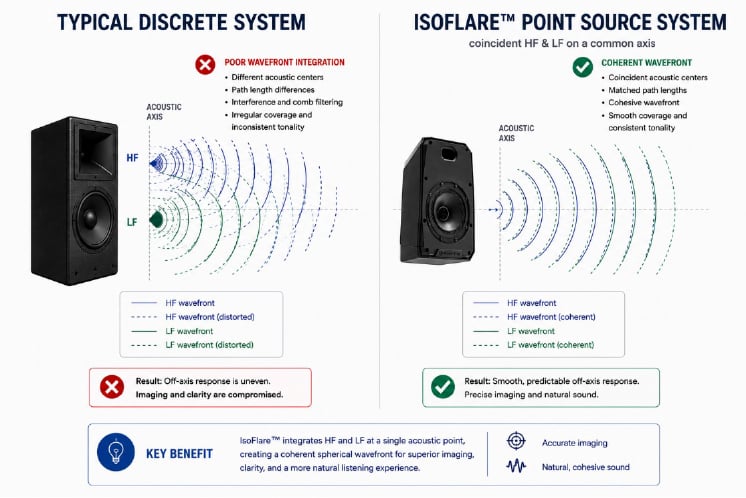
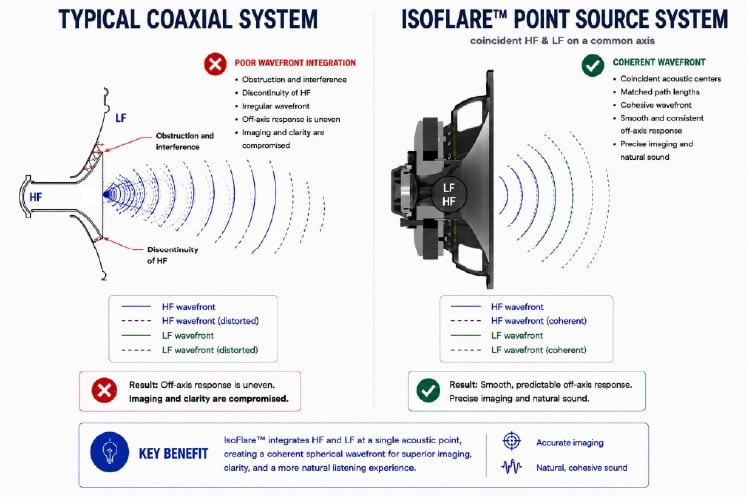
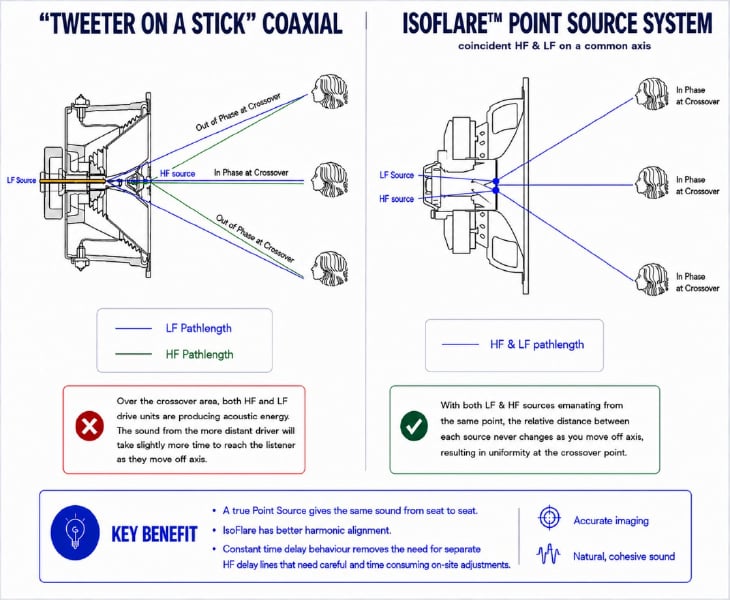
The benefits of a well-voiced product family include seamless transitions between speaker models, a consistent listener experience throughout a facility, and easier system expansion and upgrades over time.
Reduced DSP correction requirements
A well-voiced loudspeaker starts with a balanced acoustic response. That means less equalization is required during commissioning, faster system tuning, more predictable results across installations, and greater preservation of amplifier headroom. Instead of using DSP to correct major speaker deficiencies, the DSP can be focused entirely on room-specific optimization — which is where it should be applied.
Improved user experience across content types
Commercial AV systems increasingly handle mixed-content workloads: voice conferencing, background music, digital signage, video playback, and live presentations, often in the same space. Proper voicing allows all of those content types to sound natural and engaging. Users may not consciously notice good voicing — but they immediately notice poor sound quality.
Brand and manufacturer differentiation
Published specifications do not describe tonal balance, transient response, perceived clarity, or listening fatigue. Two loudspeakers with similar specifications can sound very different. Voicing is where manufacturers establish their sonic identity and differentiate themselves in competitive markets. It is an engineering decision, not a marketing one, and it reflects the manufacturer's priorities and application expertise.
Coverage uniformity and system integration
Voicing extends beyond frequency response. It can involve crossover design, driver integration, phase alignment, and directivity management. When loudspeakers are voiced correctly, overlapping coverage zones blend more naturally, creating a uniform listening experience throughout a space. This is especially important in large distributed audio systems, stadiums and arenas, hospitality venues, and retail environments where many speakers share coverage responsibility.
Listener fatigue reduction
Commercial spaces often expose occupants to audio for hours at a time. Poor voicing — excessive high-frequency energy, harsh vocal reproduction, uneven tonal balance — compounds over the course of a day. Good voicing produces natural sound reproduction, comfortable long-term listening, and improved satisfaction for employees, customers, students, and attendees.
What this looks like in practice
Consider a corporate boardroom equipped with high-end microphones, DSP, and video conferencing equipment. If the loudspeakers are poorly voiced, remote participants sound thin or harsh, speech intelligibility suffers, users compensate by increasing volume, and meeting fatigue increases. With properly voiced loudspeakers, voices sound natural and present, lower playback levels are sufficient, meeting participants stay engaged longer, and the system is perceived as higher quality — even if no one in the room can identify why.
The bottom line
In commercial AV, loudspeaker voicing directly affects intelligibility, user satisfaction, system consistency, tuning efficiency, and overall project success. The best commercial loudspeakers are engineered so that their inherent voicing supports the application's goals before any DSP tuning is applied — allowing integrators to achieve predictable, repeatable results across diverse environments.
Frequently asked questions
What is loudspeaker voicing?
Loudspeaker voicing is the engineering process of shaping a speaker's frequency response, tonal balance, phase behavior, and sonic character so it reproduces audio in a predictable and desirable way. It determines how a loudspeaker sounds, not just what its measurements indicate.
Why doesn't the spec sheet tell me how a loudspeaker is voiced?
Published specifications describe measurable performance parameters — sensitivity, frequency range, maximum SPL — but do not capture tonal balance, transient response, perceived clarity, or listening fatigue. Two loudspeakers with identical specs can sound very different. Voicing is what accounts for that difference.
How does voicing affect speech intelligibility?
Proper voicing emphasizes the frequency ranges most critical for consonant recognition, typically around 1–4 kHz, while avoiding excessive brightness that causes fatigue. This directly improves Speech Transmission Index (STI), word recognition accuracy, and listener comfort — all of which matter more than peak volume in speech-focused applications.
Does voicing eliminate the need for DSP?
No, but it reduces how much corrective work DSP needs to do. A well-voiced loudspeaker starts with a balanced acoustic response, which means commissioning is faster, tuning is more predictable, and DSP can focus on room-specific optimization rather than compensating for speaker deficiencies.
Why is consistent voicing across a product family important?
In facilities that use multiple speaker types — ceiling, pendant, surface-mount — consistent voicing across the product line ensures the tonal character remains uniform as listeners move through different spaces. This is more difficult than it sounds, because different form factors often use different driver configurations (coaxial vs. discrete), requiring deliberate engineering to achieve a matching sonic signature.