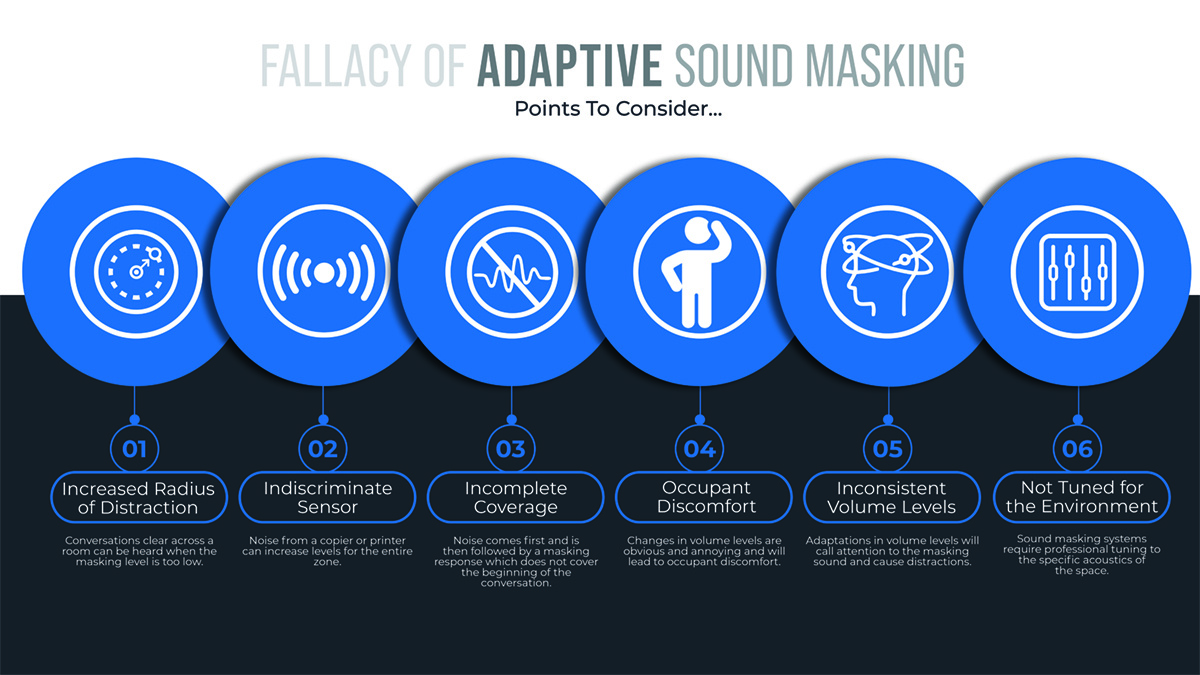


Adaptive sound masking, which adjusts masking noise levels in response to ambient sounds, may inadvertently draw attention to the masking system itself, leading to increased distractions and reduced speech privacy. Consistent sound masking is more effective, as it remains unobtrusive and maintains a stable acoustic environment.
Ambient noise compensation is sometimes referred to as adaptive audio. While adaptive paging, emergency notifications, and even background music is good, adaptive sound masking may create more problems than it solves. With respect to paging, adaptivity is helpful because it makes sure that the signal-to-noise ratio is high, producing a more intelligible page.
Conversely, sound masking is only effective when it goes unnoticed. Any variation in volume will call attention to the masking sound and may result in distractions and dissatisfaction with the space- the challenges that masking is designed to reduce. For example, if the masking generator was set to increase the volume of the masking “noise” as the office was fuller, and then reduce the volume when the office was less full, those working in the space throughout the day would not become habituated to the consistency of the sound. As we have mentioned before, employees and tenants returning to offices where distractions are minimized and speech privacy is upheld will result in higher employee satisfaction and productivity.

- Adaptive masking increases the radius of distraction. Conversations clear across the room can be heard as the masking is too low. It also decreases the privacy of those conversations.
- The “sensor” used to detect any increase in human speech is indiscriminate. The copier/printer will trigger an increase for the entire zone.
- The masking spectra chases the dynamics of the office noise resulting in noticeable variations in volume. The noise comes first and is then followed by the masking response. A one or two minute system response cannot cover up the beginning of any conversation. Therefore, adaptive masking can only reduce the level of privacy. It cannot increase privacy.
- Swings between low level and high level are obvious, annoying, and will lead to occupant discomfort.
- Reducing masking or turning it off is only recommended for security reasons such as night security personnel wanting to hear everything or when an emergency alert is triggered.
- Sound masking systems must be tuned to the environment by a professional trained in sound masking tuning. Adaptive sound masking is not tuned to the acoustics of the office space.